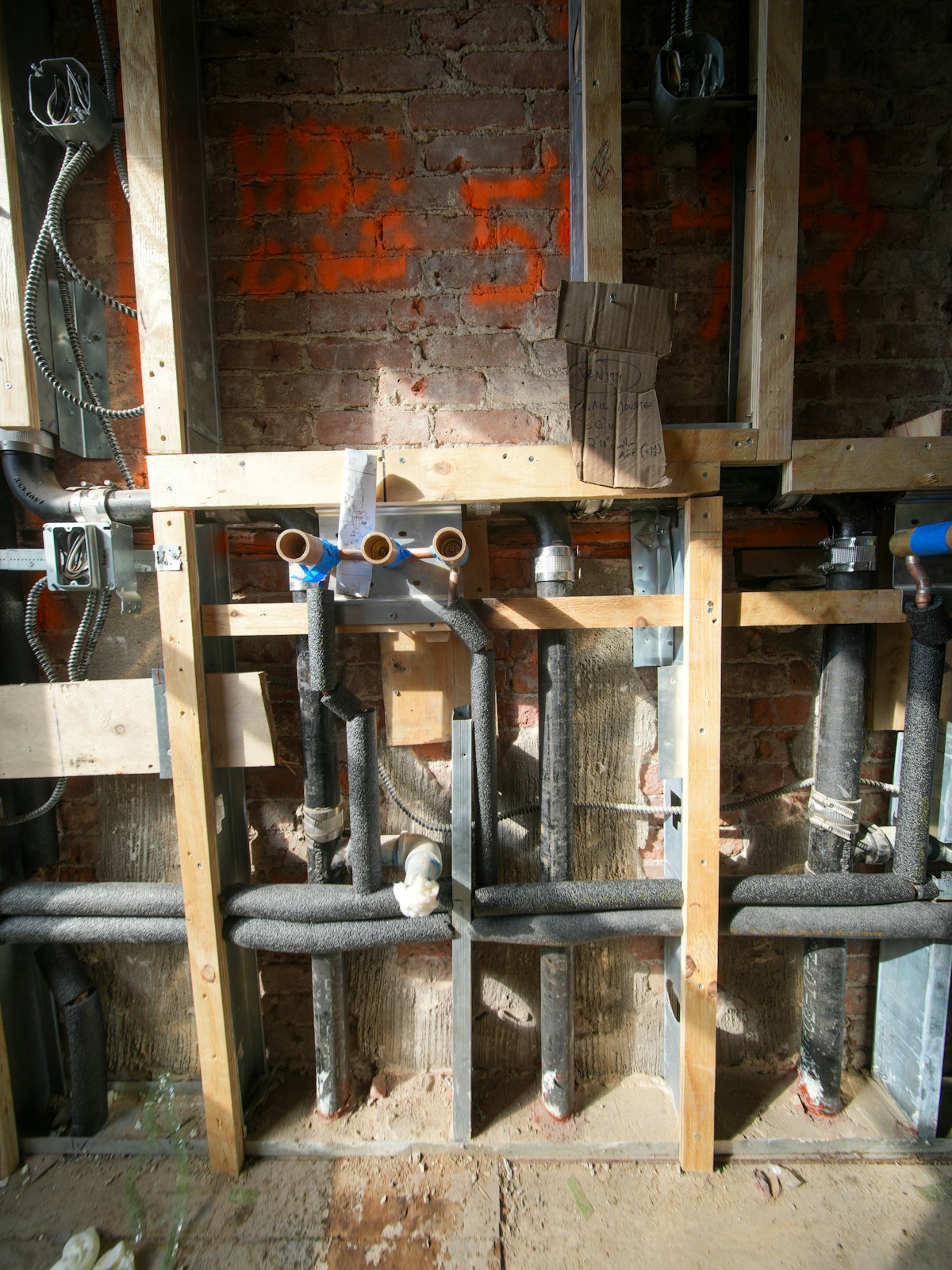
Getting the wrong core drill size for a waste pipe penetration is a slow, frustrating mistake. Too small and the pipe cannot be fitted without deforming the socket end. Too large and the gap around the pipe allows cold air ingress, vermin entry, and — in a cavity wall — interstitial moisture movement that no amount of silicone properly addresses.
This guide sets out the correct core drill size for every standard UK waste and soil pipe diameter, explains why the outer diameter is always larger than the nominal bore, and covers the sleeve and sealing approach required by Part H of the Building Regulations.
Why Nominal Pipe Size Is Not What You Drill
UK plastic waste and soil pipes are sized by their nominal bore — the approximate internal diameter. But what physically passes through the wall is the outer diameter of the pipe, which is always larger. A 110mm nominal soil pipe, for example, has an outer diameter of around 110mm to 111mm. But you cannot drill 110mm — the pipe cannot be inserted without significant force, the socket fittings will not pass at all, and any slight deviation in the drill angle means the hole is undersized on one side.
The correct approach is to add 10–15mm to the outer diameter of the pipe. This gives clearance for the pipe to run through the wall at a slight angle (essential for waste pipes which need a fall), allows a proper wall sleeve to be fitted, and leaves room for a fire-rated sleeve collar if the wall is a fire-compartment boundary.
Core Drill Size by Waste Pipe Diameter
| Nominal Pipe Size | Outer Diameter (OD) | Recommended Core Drill Size | Typical Use |
|---|---|---|---|
| 32mm | ~36mm | 50mm | Washing machine standpipe, appliance waste |
| 40mm | ~43mm | 55mm or 57mm | Basin, bidet, kitchen sink waste |
| 50mm | ~56mm | 68mm or 70mm | Bath waste, shower tray waste |
| 110mm (soil) | ~110mm | 125mm or 127mm | Soil/vent stack, WC connection |
| 160mm (large soil) | ~160mm | 175mm or 180mm | Underground drain transition, large stack |
For the 110mm soil pipe — by far the most common large-bore installation — 125mm is the standard trade size. This gives roughly 7.5mm clearance around the pipe OD, sufficient for a standard wall sleeve and still small enough to be covered by a 150mm flange plate. The core drill bit sizes chart shows availability across all common manufacturers for these dimensions.
40mm Basin and Kitchen Sink Waste
40mm waste pipe (the standard for UK basins and kitchen sinks) has an OD of around 43mm. The correct core drill size is 55mm, which some manufacturers list as 57mm — these are effectively the same trade specification. At this diameter, an SDS Plus drill with a 55mm dry core bit is perfectly adequate for brick or block walls. You do not need a dedicated core drill motor for 55mm — a good SDS Plus machine at 900W or above will cut this without issue.
The mistake to avoid: do not use a 40mm core bit on a 40mm waste pipe. The socket end of a standard 40mm push-fit fitting is approximately 48–50mm. Even if the pipe barrel passes through a 40mm core, the fitting will not, and you will end up chiselling out the hole by hand.
50mm Bath Waste
Bath waste and shower tray waste runs at 50mm nominal bore with an OD of approximately 56mm. Use a 68mm or 70mm core bit. At this size, most dedicated SDS Plus machines will manage in soft brick and block. For dense block or concrete, use a 900W-plus machine with the correct adaptor — see the SDS adaptor guide for the torque limits.
110mm Soil Stack — the Most Common Large-Bore Installation
110mm soil pipe is the UK standard for soil and vent stacks, WC connections, and underground-to-above-ground transitions. The core drill size is 125mm. This is a size that benefits from a dedicated core drill motor rather than an SDS adaptor, particularly through blockwork, dense concrete ground floor slabs, or brick.
Key considerations for 110mm soil pipe penetrations:
- Fall: Waste pipes must run at a minimum 1:40 gradient (BS EN 12056). Through a 300mm cavity wall, a 1:40 fall requires the exit point to be approximately 7.5mm lower than the entry point. Allow for this when marking the hole position.
- Fire stopping: Where the pipe passes through a fire-compartment wall or floor (between properties in an HMO, between garage and living space, between floors in some flat conversions), an intumescent fire sleeve collar is required by Part B of the Building Regulations. The collar fits around the pipe and must be embedded in the wall at the point of penetration.
- Acoustic insulation: In multi-occupancy buildings, acoustic pipe wrap is required under Part E. Fit it before sleeving the pipe through the wall.
Drilling Technique for Waste Pipe Penetrations
Waste pipe penetrations are different from boiler flue or extractor fan holes in one important respect — the pipe must follow a gradient, which means the drill angle is never precisely horizontal. For a basin waste running through an external wall to a hopper head outside, the typical fall is 6–12mm over a 300mm wall thickness. Mark the entry and exit points separately, confirm the gradient with a spirit level, and set the drill up at the correct angle before cutting.
For an explanation of how to set up and drill accurately at an angle, see the how to use a diamond core drill guide, which covers pilot pins and angle alignment technique.
Use a dry diamond core bit for standard brick and block installations. For ground floor slab penetrations in dense concrete (common where a soil stack exits through a ground floor slab to underground drainage), switch to a wet-rated or universal core bit — see the dry vs wet drilling guide.
Sealing After Installation
After the pipe is in position:
- Pack around the pipe with a compressible mineral fibre collar or proprietary pipe sleeve.
- Fire-stop if required (intumescent sealant or sleeve collar for compartment walls).
- Seal the visible face with a compatible mastic or pipe collar plate — do not use frame sealant on external masonry faces as it degrades with UV.
- Check the sleeve has not compressed the pipe and restricted flow — run a test charge of water before finishing.